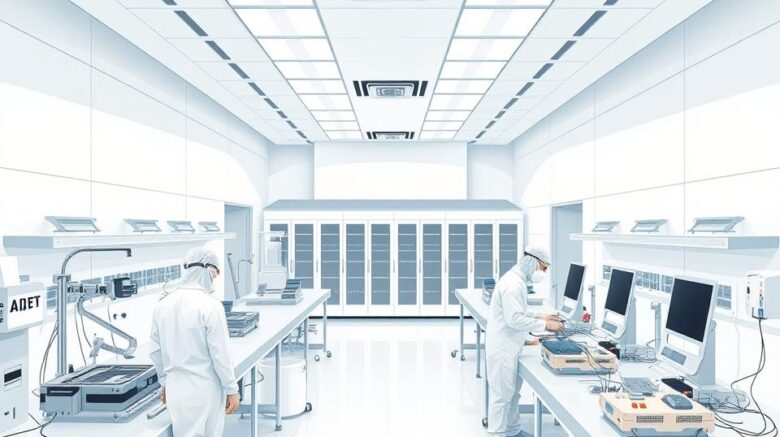
AMT Singapore: Trusted Clean Room Assembly for Medical Technology
Nearly 70% of medical device contamination originates from assembly or transport. This underscores the critical role that cleanroom assembly plays in ensuring both patient safety and securing product approvals.
With more than three decades of experience in medical clean room assembly by AMT, AMT Medical Clean Room Assembly Services is a key player in Singapore. They have around 350 employees and serve more than 30 countries. This makes Singapore as a key place for medical clean room construction and precise assembly work.
AMT is certified in ISO 13485, ISO 9001, and IATF 16949. They utilize stringent quality systems to support programs for regulated devices. Their facilities include support for Class 100K (ISO Class 8) clean rooms. They also offer services like single-site injection molding, tooling, and assembly. This helps lower the risk of contamination and streamlines the process.
This piece describes how AMT’s medical clean room assembly supports regulatory compliance. It also explores how they manage microbe control and integrate processes. These initiatives allow medical manufacturers to get their products to market more quickly. They also serve to protect the sterility of products and safeguard intellectual property.
Summary of AMT Medical Clean Room Assembly offerings
Based in Singapore, AMT Pte. Ltd. has served as a trusted partner in the manufacturing of medical devices for over three decades. They work with clients from over 30 countries and have robust ties with suppliers in Asia. Around 350 local employees work at the Singapore headquarters to provide regional support.
AMT is renowned for its high-quality standards, thanks to key certifications. ISO 13485 ensures their processes meet medical device regulations. ISO 9001 guarantees quality management across all operations. Their IATF 16949 certification showcases their proficiency in automotive-grade process control, which is a great benefit for assembling medical devices.
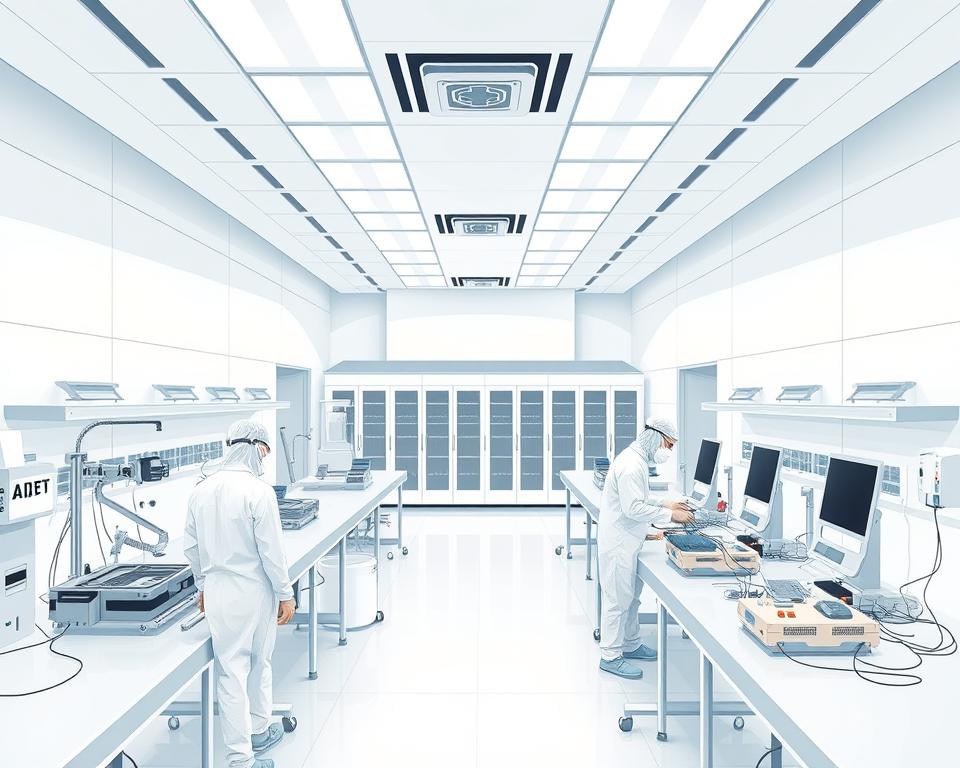
One of AMT’s major strengths is its single-site integration. Everything from tooling and 3D metal printing to metal and ceramic injection molding and clean room assembly is managed in one place. This method leads to shorter lead times and a reduced risk of contamination.
Both sterile and non-sterile products can be handled by AMT’s clean room assembly services. Their integrated workflows for molding, inspection, packaging, and assembly improve traceability and quality control. This makes production smoother.
AMT’s vertical integration model is a great advantage for clients requiring assembly in controlled environments. Positioning tooling and molding operations near the cleanroom reduces the steps involved in handling. This also simplifies logistical challenges and guarantees consistent control over the environment.
AMT’s Services for Medical Clean Room Assembly
AMT provides medical clean room assembly services. These services assist medical device makers in Singapore and surrounding areas. Their focus is on clean production within areas classified as ISO Class 8. In these areas, components are manufactured, assembled, and packaged according to stringent cleanliness protocols. AMT offers all-in-one services for molding, assembly, validation, and checking for microbes.
Definition and primary services offered under this keyword
Medical clean room assembly is a specialty of AMT. This work is carried out in specialized cleanrooms for parts of medical devices. Key services include cleanroom molding, component assembly, final packaging, environmental monitoring, and microbial testing. AMT contributes to the production of surgical parts and devices that demand a sterile environment.
The Role of Class 100K (ISO Class 8) Cleanrooms in Device Manufacturing
The air in Class 100K cleanrooms is maintained at a level of cleanliness suitable for a wide range of assembly tasks. This is effective in preventing particle contamination for devices such as endoscope components. Regular checks of the air, differential pressure, humidity, and temperature are conducted by AMT. This practice ensures they remain compliant and maintain thorough documentation.
Benefits of vertical integration for contamination control and logistics
Contamination is more easily avoided when molding and assembly are co-located. It makes for shorter lead times and simpler quality checks. AMT’s way reduces issues, enhances tracking, and saves on costs because of less moving around.
This way of working helps keep AMT’s production processes clean and focused. It leads to superior products and simplified documentation for manufacturing clients. They rely on AMT to meet their requirements.
Cleanroom classifications and compliance for medical device assembly
Understanding cleanroom classes helps to match the right environment to product risks. Cleanroom assembly compliance depends on setting clear particle limits, doing regular checks, and having proof of validation. This section delves into the standards for ISO Class 8. It also covers monitoring methods that keep medical assembly lines up to par in Singapore and other places.
ISO Class 8 requirements
The maximum allowable concentration of airborne particles, categorized by size, is defined by ISO Class 8 cleanroom standards. For numerous medical device assembly tasks that do not require absolute sterility, these cleanrooms are ideal. The industry often calls it Class 100K. This designation is commonly used for tasks involving plastic injection molding and assembly.
Practices for Validation and Monitoring
Routine environmental checks are critical for medical cleanrooms. To ensure air particle levels remain within predefined limits, facilities monitor them closely.
Teams check the pressure difference between areas to keep the air moving correctly. They also control temperature and humidity to stop product damage and lower the chance of contamination.
Regular validations are performed, and detailed records are kept to prove compliance with regulations. Dedicated teams conduct microbial checks to detect potential issues early on and implement corrective actions as needed.
Alignment with Regulations
Meeting the rules set by bodies like the US Food and Drug Administration and the European Medicines Agency is vital. For device manufacturers, maintaining ISO 13485 certification and comprehensive validation records is key to passing audits and completing regulatory submissions.
Having good records of cleanroom procedures, doing requalifications regularly, and tracking data proves manufacturers have everything under control during inspections. Building medical cleanrooms to these standards makes passing regulatory checks easier and speeds up time to market.
Integrated manufacturing: injection molding and clean room assembly
Having both molding and assembly in one place makes producing medical equipment more streamlined. It means less moving around inside the facility. Additionally, it simplifies quality monitoring, from the initial molding stage to the final packaged item.
Advantages of single-site integration
When both injection molding and assembly are co-located, handling of parts is significantly reduced. This leads to quicker prototype development and more rapid start of production. It facilitates close cooperation between the tooling, molding, and assembly teams. This ensures the quality checks meet the same high standards.
Reduction of contamination risk and logistical cost savings
The risk of contamination is lowered by eliminating the need to move items between different locations. There is also a reduction in costs associated with packaging, shipping, and handling. Centralizing all operations simplifies the management of quality control and regulatory compliance. This makes clean room assembly more efficient.
Product Type Examples Ideal for Integrated Processes
Products like endoscopic pieces, housings for surgical instruments, and parts for minimally invasive devices do well in this integrated system. Depending on the sterilization and packaging, both sterile and non-sterile items can be made.
| Type of Product | Primary Integration Benefit | Typical Controls |
|---|---|---|
| Lenses and housings for endoscopes | Less particle transfer from molding to optics assembly | Particle counts, ISO-classified assembly zones, validated cleaning |
| Housings for surgical instruments | Better dimensional control and batch traceability | Material lot tracking, in-line inspection, sterilization validation |
| Minimally invasive device components | Efficient change control for fast design updates | Molding in a controlled environment, testing for bioburden, documenting processes |
| Disposable diagnostic housings | Reduced logistics costs and quicker market entry | Supply chain consolidation, batch records, final inspection |
Opting for a facility that manages both clean room assembly and cleanroom injection molding ensures improved quality control and dependable production schedules for medical devices. This approach reduces risks and maintains value, from the initial prototype to the final product shipment.
Use Cases and Environment Choices for Medical Device Assembly
It is essential to select the appropriate environment for medical device assembly. Options available from AMT range from stringent ISO-classified rooms to controlled white rooms. This adaptability allows for matching the assembly process to the risk level of the specific device.
When to choose a cleanroom vs. a white room for assembly
Use an ISO-classified cleanroom when specific cleanliness levels are required. This applies to devices such as implants and sterile disposable products. They are protected during assembly and packaging in cleanrooms.
Choose white room assembly if higher particle counts are acceptable. It continues to offer controlled conditions, including managed air flow and filtered HVAC systems. This option keeps quality up and costs down for many devices used outside the body.
Risk Profiles of Devices Requiring ISO-Classified Environments
Certain devices need sterile assembly environments. Examples are implants and surgical instruments. Assembly for these items usually occurs in sterile and clean settings.
ISO-classified spaces should be used if a device affects health or if its performance is sensitive to particles. AMT’s cleanrooms offer validated controls for high-risk product assembly.
Lower-risk assemblies suitable for standard controlled environments
Devices used outside the body or parts needing later sterilization fit standard environments well. They are cost-effective and adhere to good manufacturing practices.
Conducting assembly in non-ISO environments can accelerate the market launch of low-risk products. It delivers quality without incurring the high costs associated with stringent cleanroom standards.
| Assembly Setting | Typical Use Cases | Primary Control Measures | Impact on Cost |
|---|---|---|---|
| ISO-classified cleanroom | Sterile disposables, implants, instruments for invasive procedures | HEPA filters, particle count monitoring, gowning protocols, validated processes | Significant |
| Assembly in a White Room | External-use devices, components for later sterilization | Access control, hygiene protocols, filtered HVAC systems | Moderate |
| Controlled Standard Environment | Prototypes, non-sterile subassemblies, low-risk parts | Cleaning schedules, basic contamination controls, traceability | Minimal |
Quality assurance and microbiological controls in clean room assembly
Medical equipment safety and reliability are ensured by robust quality systems. Clean room standards are adhered to by AMT. These standards comply with ISO 13485 and the particular requirements of Singapore. Keeping detailed records and doing regular checks are key for meeting clean room rules across all manufacturing stages.
Schedules for Validation and Documentation Practices
Planned validation includes checks of the environment, equipment, and processes. This includes counting particles and microbes, logging pressure differences, and tracking temperature and humidity. CAPA (Corrective and Preventive Action) traces are also documented. All these records help demonstrate that we meet the strict clean room rules for medical equipment.
Teams and Routines for Microbiological Inspection
Special teams focus on checking surfaces and air, and analyzing cultures. They identify trends, look into anomalies, and verify the effectiveness of cleaning procedures. Their responsibility is to maintain stringent control over microbial levels. This assists in preventing contamination of sterile and sensitive medical instruments.
Controls for Traceability, Batch Records, and Packaging
Detailed records are maintained for every medical device. This information covers materials, machine parameters, and operator details. Packaging procedures vary depending on the risk associated with the device. Sterile devices get special sterile packaging. Non-sterile ones get packaging that protects them but is not sterile. Each step makes sure everything is done right, from beginning until it’s sent out.
| Element of Quality | Common Activities | Expected Outcomes |
|---|---|---|
| Validation schedule | Regular qualification runs, revalidation following change control, seasonal checks of the environment | Protocols for validation, reports on acceptance, certificates for requalification |
| Monitoring of the Environment | Sampling of air and surfaces, counting particles, monitoring differential pressure | Logs kept daily, charts showing weekly trends, reports on exceptions |
| Oversight of Microbiology | Culture testing, rapid alert investigations, cleaning efficacy studies | Results from microbial tests, actions for correction, validations of methods |
| Product Traceability | Tracking of material lots, records of operators and equipment, histories of digital batches | Full batch records, lists of serialized lots, trails for auditing |
| Packaging control | Runs of validated sterile packaging, checks on sealing integrity, verification of labeling | Packaging validation reports, sterility assurance documentation, shipment records |
Supporting Technical Capabilities for Medical Equipment Manufacturing
AMT mixes exact part tech with cleanroom assembly for medical gear making in %place%. These skills allow design teams to go from idea to approved item fast. This happens without waiting long for different companies.
Metal and ceramic injection molding create detailed features that plastics can’t. Parts made from stainless steel and cobalt-chrome are produced for instruments and implants. Ceramics make parts for checking health and replacing body parts that last a long time and are safe for the body.
Creating tools in-house ensures molds and dies are just right in size and smoothness. Rapid tool modifications significantly cut down on waiting times and lower the risk associated with parts that require a perfect fit. It also keeps costs down when making more for sale.
3D metal printing makes making samples faster and allows for complicated shapes. Engineers check the shape, working, and fitting this way before making lots. Mixing 3D printing with usual molding makes getting new medical items out faster.
The joining of dissimilar materials, such as metal, ceramic, and plastic, is made possible by these techniques. Techniques for joining, like overmolding, are carried out in clean environments to maintain precision. This results in reliable assemblies for surgical instruments, diagnostic equipment, and implantable components.
Using metal and ceramic injection molding, making tools, and 3D printing lets makers have one ally. This partner assists with sampling, validation, and the production of more sophisticated medical devices. It reduces the complexity of managing multiple groups, protects intellectual property, and streamlines the process of obtaining regulatory approval.
Supply chain advantages and IP protection for contract manufacturing
AMT’s Singapore hub combines sourcing, production, and distribution closely. This supports making medical equipment on a large scale. Centralized workflows are designed to reduce lead times and facilitate planning for large volume orders. For companies that require reliable components and consistent timelines, this approach offers distinct supply chain advantages.
Steady access to materials and effective cost management are ensured through strong partnerships in Asia. Trusted vendors in Malaysia, Thailand, and Vietnam are among AMT’s collaborators. This ensures the availability of necessary materials, components, and logistical support. Such a network streamlines shipping and ensures timely deliveries for urgent projects.
During contract manufacturing, AMT implements serious measures to safeguard clients’ intellectual property. They use confidentiality agreements and control access to engineering files. The safety of client designs and processes is also enhanced through segmented production lines. These measures comply with the stringent standards of regulated industries, which ensures the security of tooling and prototype development.
Audit-ready processes and skilled staff help protect IP and meeting regulatory requirements. A traceable record is created by documenting design transfers, modifications, and supplier information. This reduces risks when moving from prototype to mass production in a medical clean room.
The Singapore platform is designed to scale up, serving customers in over 30 countries. This setup allows AMT to increase production without complicating processes. So, companies can smoothly go from small test runs to making large quantities of surgical tools and diagnostic devices.
Customers enjoy predictable planning and different choices for regional transport. This accelerates reaching the market. For medical equipment companies, working with a partner who manages local logistics and IP security is smart. It provides an efficient method for global distribution while safeguarding proprietary technology.
Operational efficiency and cost considerations for clean room projects
The management of clean room projects centers on the factors that drive budgets and timelines. The costs of clean room assembly are weighed against the benefits in quality and speed by the teams. AMT’s approach in Singapore demonstrates how to manage expenses while meeting standards.
Costs depend on cleanroom level, validation extent, and monitoring intensity. High levels require better HVAC and filtration, leading to higher initial and ongoing costs.
Validation and monitoring increase costs with tests and paperwork. These activities are crucial for complying with the standards set by agencies such as the US FDA. Costs of requalification and constant data gathering need planning.
Integrating manufacturing reduces expenses. This minimizes transportation needs and the requirement for multiple validations. In the context of medical device assembly, this approach frequently leads to cost savings.
Project timelines can be shortened by collaborating with a partner that offers full-service clean room solutions. This leads to better coordination and traceability, which in turn reduces the total costs.
Choosing the right quality level involves trade-offs. More controlled environments are required for devices that pose a high risk. Less demanding conditions are suitable and more economical for simpler components.
Efficiency comes from strong quality systems like ISO 13485. Aligning with regulations early on supports innovation while maintaining a focus on being ready for production and validation.
All costs and the risks of rework should be weighed when deciding on a production environment. This balanced view ensures projects meet standards while saving money.
Customer industries and product examples served by AMT
AMT assists a lot of medical customers in Singapore and other parts of Asia. They make parts for hospitals, device OEMs, and labs. They range from one-off prototypes to large batches for medical equipment.
Here are some ways AMT helps certain products and industries. They align their manufacturing capabilities with the requirements for quality and application.
Components and Assemblies for Surgery and Endoscopy
AMT makes things like optics housings and grip modules for surgery. Assembly is conducted in cleanrooms to prevent particulate contamination. This production process adheres to strict standards for dimensions, surface finish, and clinical application.
Consumables and Components for Medical Diagnostics
They make disposable items like syringe parts and test cartridge houses. To comply with regulations, AMT integrates clean assembly with tracking systems. The diagnostic components they produce include items like sample ports and test holders.
Implants and high-precision parts
The production of implantable components using specialized materials and techniques is supported by AMT. They use metal and ceramic molding for these parts. Rigorous checks are implemented for safety documentation and manufacturing history.
Examples, Patents, and Awards
AMT has 29 patents in 12 countries and 15 inventions. These patents and inventions underpin their distinctive tooling, metal processing, and assembly configurations. Their awards in metalworking show their skills that help make medical devices.
| Product Type | Typical Processes | Primary Quality Focus | Representative End Market |
|---|---|---|---|
| Endoscopic toolheads | Injection molding, cleanroom assembly, ultrasonic welding | Precision in dimensions, low generation of particulates | Surgical hospitals, ambulatory centers |
| Consumables for Single Use | Manufacturing of medical consumables, automated molding, packaging | Assurance of sterility for sterile products, traceability | Labs for clinical use, care in emergencies |
| Diagnostic cartridges | Assembly of chambers for reagents, micro-molding, testing for leaks | Fluid integrity, lot-to-lot consistency | Point-of-care diagnostics, centralized labs |
| Implantable components | Finishing, metal injection molding, validated procedures for cleaning | Files on manufacturing history, biocompatibility | Dental, orthopedics, cardiovascular fields |
| Precision Parts (MIM/CIM) | Powder metallurgy, heat treatment, secondary machining | Material properties, mechanical reliability | Assembly of medical devices – %anchor3%, manufacturers of instruments |
Wrapping It Up
The operations of AMT in Singapore are a testament to high-quality medical device assembly within clean room environments. They are certified with ISO 13485, ISO 9001, and IATF 16949. They also have Class 100K cleanrooms. This means AMT can handle complex tools for diagnostics, surgical parts, and implants safely.
In their approach, multiple processes are combined at a single location. This includes on-site capabilities for injection molding, tooling, MIM/CIM, and 3D metal printing. This reduces the risk of contamination and cuts down on transport times. Safe assembly of medical devices in Singapore is ensured by this method. It also protects intellectual property and improves teamwork with suppliers in Asia.
AMT provides strong quality assurance and options for microbiological control. Teams can choose cleanroom classes based on the risk of the device. This approach creates a balance between cost, regulatory compliance, and time to market. For firms looking for a reliable partner, AMT’s medical clean room assembly is a smart choice. It promises scalable, reliable production in Asia.